Efficient Lab Structure
Page Object Pattern in Automation Testing Overview
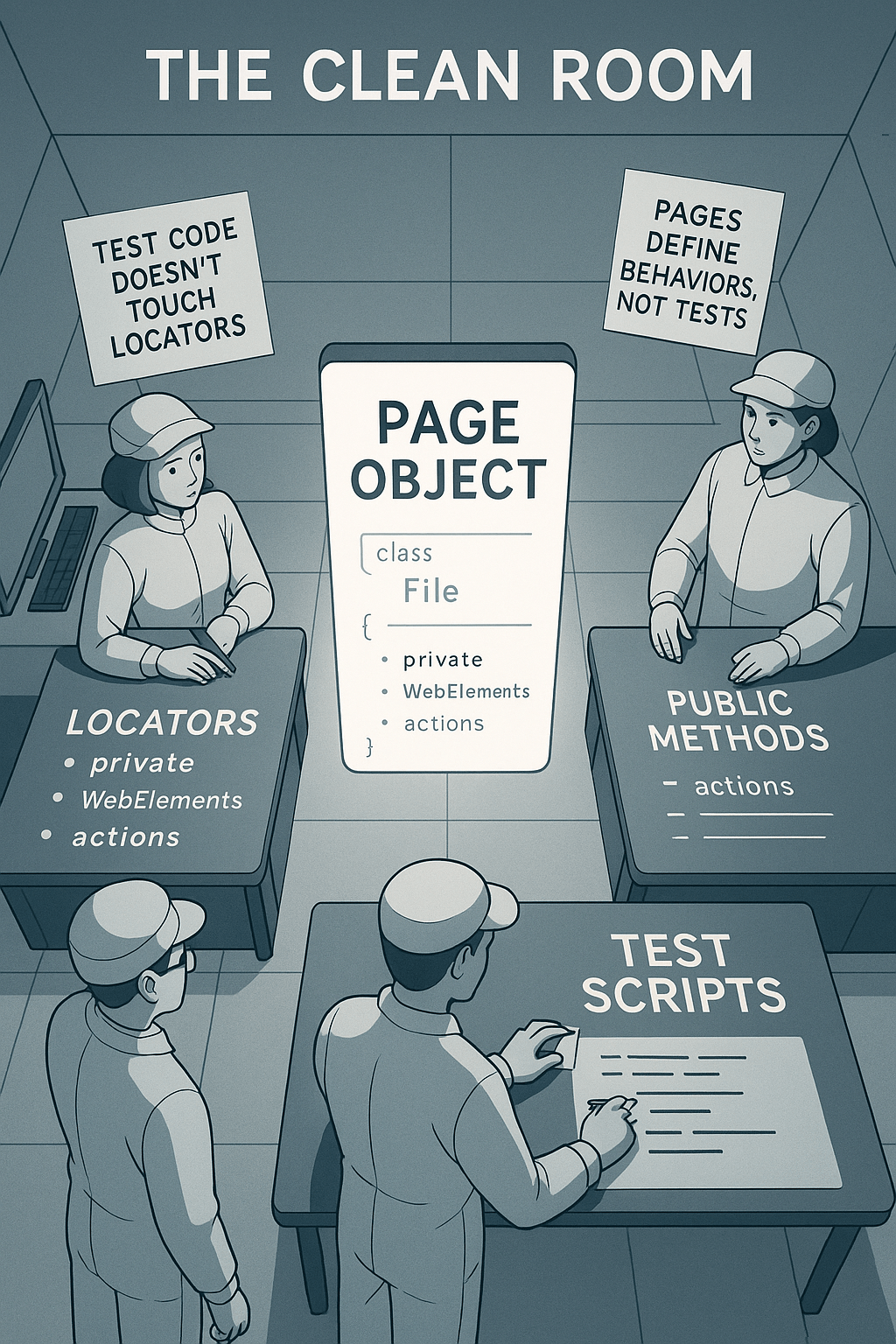
Page Object pattern in automation testing is a vital structure that promotes clean, maintainable, and scalable test frameworks. This powerful design separates test logic from web element locators and actions. In the visual above, four roles sit around the central “Page Object” class file—each managing a dedicated piece of the testing workflow. Moreover, this approach ensures your test code never directly touches locators. Instead, the Page Object class stores all private web elements and defines public methods to represent user behaviors. In addition, test scripts interact with these methods rather than the underlying elements. Therefore, if the UI changes, only the Page Object needs updates. Furthermore, this pattern leads to faster debugging, easier collaboration, and more reliable tests overall.
Key Features of Page Object Pattern in Automation Testing
- Encapsulated Locators: Web elements are defined once, in a single Page Object class.
- Reusable Methods: Public functions represent user actions like login or form submission.
- Clear Separation of Concerns: Test scripts only call methods—they don’t manage UI elements.
What’s Included with Page Object Pattern in Automation Testing
- Core Page Object class containing locators, private elements, and actions.
- Dedicated team roles: locators manager, method designer, script writer.
- Posters reinforcing clean code principles like “Test code doesn’t touch locators.”
How to Use Page Object Pattern in Automation Testing
- Create a class for each web page and name it logically (e.g., LoginPage.java).
- Define locators as private WebElements.
- Write public methods to perform user actions, like
enterCredentials(). - Call these methods in your test scripts—never duplicate locators in tests.
Ideal Uses and Placement
- Use in Selenium, Playwright, Cypress, and other UI automation frameworks.
- Perfect for test teams working on large-scale or evolving web applications.
- Ideal in QA workshops, technical documentation, and framework onboarding sessions.
- Great for visual guides in developer playbooks.
Explore More Resources
- Find similar products: Products Page
- Gain further insights: Our Blog
- Enhance your understanding: AI & QA Resources
- Learn from experts: Selenium: Page Object Models
Why Choose Page Object Pattern in Automation Testing?
The Page Object pattern in automation testing improves code readability, reduces duplication, and simplifies updates. Moreover, it helps teams maintain complex test suites more efficiently. By separating logic from elements, you boost scalability and stability in every test.
Start Building Smarter Tests with Page Object Pattern Today!
Elevate your automation strategy—adopt the Page Object pattern in automation testing for reliable and maintainable code!
$3.99
- ✅ Instant Download Available
- 🖼️ Ultra High-Resolution 4K PNG + JPG (4096×6144, 300 DPI)
- 🖨️ Prints Beautifully up to 13.6×20.5 inches
- ♾️ Unlimited Downloads
- 🔁 Commercial Use & Resale Allowed
- 💾 Digital Product – No Physical Item Shipped
- 📥 Instant Access via Download Link Post-Purchase
- 🛒 Want a Physical Print?
You can upload your downloaded artwork to services like Printful, Zazzle, or your local print shop to create stunning physical prints.
All 4K images include the label "4K" in their title.
If your selected image does not include "4K", please contact us for your complimentary upgrade.