Java Abstraction Comparison
Abstraction in Java Overview
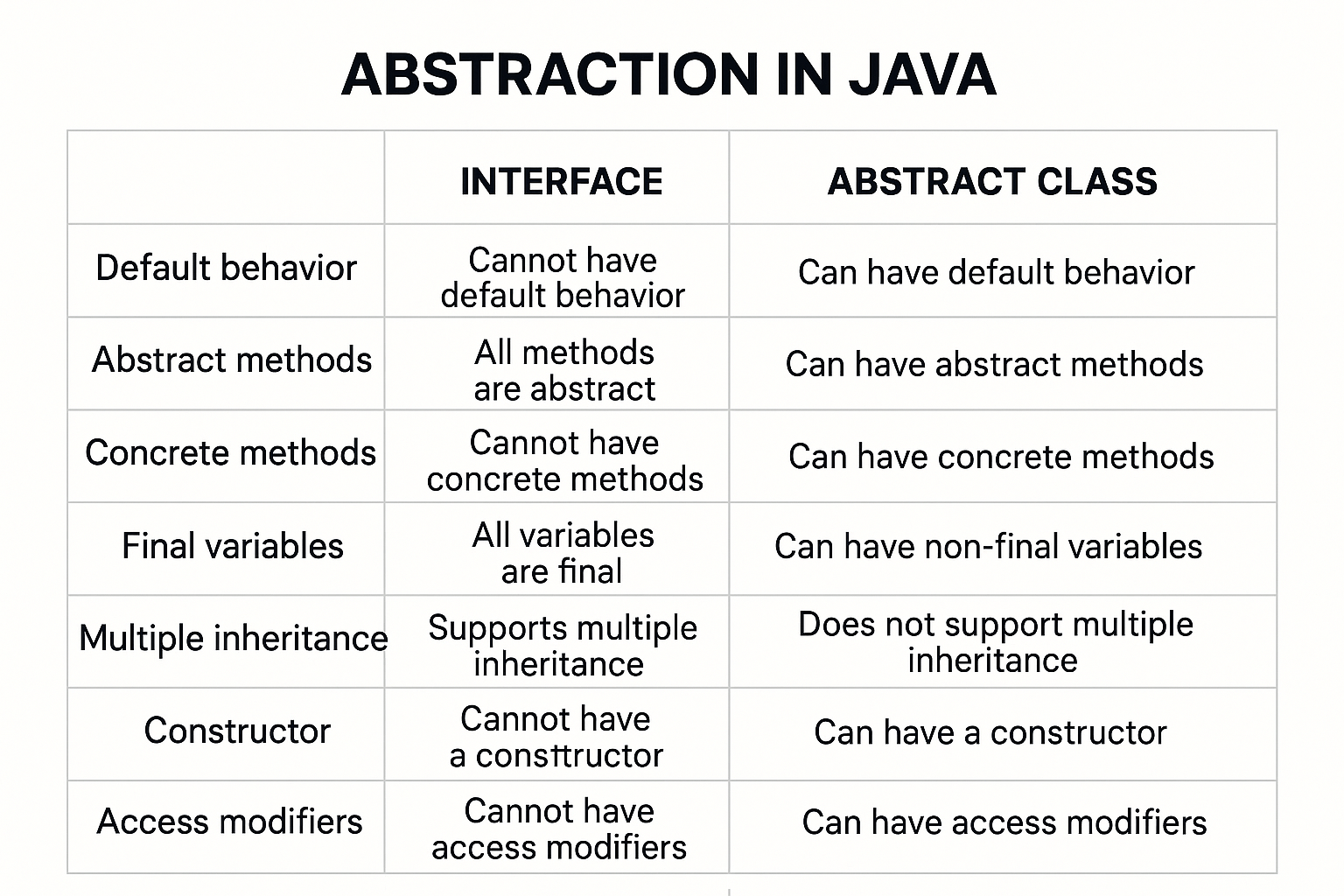
Abstraction in Java is a fundamental object-oriented concept that hides implementation details and shows only essential features. Java achieves abstraction using interfaces and abstract classes. This comparison chart illustrates the key differences between them. An interface cannot have default behavior and all methods must be abstract. In contrast, an abstract class can contain both abstract and concrete methods, and even default behavior. Moreover, interfaces enforce a strict contract, making them ideal for defining capabilities across unrelated classes. Abstract classes allow partial implementation and shared logic among related subclasses. Furthermore, interfaces support multiple inheritance, while abstract classes do not. Variables in interfaces are always final, whereas abstract classes allow non-final variables. Therefore, choosing between interface and abstract class depends on the design requirement. Java developers use interfaces for decoupled, reusable code and abstract classes when shared functionality is needed. Understanding abstraction in Java ensures better code modularity, flexibility, and maintainability.
Key Features of Abstraction in Java
- Interface Limitations: Interfaces cannot have constructors, concrete methods, or access modifiers on methods.
- Abstract Class Flexibility: Abstract classes can define constructors, non-final variables, and concrete methods.
- Inheritance Control: Interfaces support multiple inheritance; abstract classes do not.
What’s Included with Abstraction in Java
- Side-by-side comparison of interface and abstract class features in Java.
- Clarification of method behavior, inheritance, and variable rules for both constructs.
How to Use Abstraction in Java
- Use an interface when designing unrelated classes that share common behaviors.
- Use an abstract class when you want to provide shared logic among related subclasses.
Ideal Uses and Placement
- Use interfaces for event handling, service layers, and plugin-like architectures.
- Use abstract classes for core logic in class hierarchies where default behavior is beneficial.
Abstraction in Java Specifications
- Interfaces: No constructors, all methods abstract, all variables final.
- Abstract classes: Can have constructors, concrete methods, and non-final variables.
Comparison table of abstraction in Java using interface vs abstract class”
Explore More Resources
- Find similar products: Products Page
- Gain further insights: Our Blog
- Enhance your understanding: AI & QA Resources
- Learn from experts: Oracle Java Abstraction Guide
Why Choose Abstraction in Java?
Abstraction improves code structure by focusing on essential features. Moreover, it enhances reusability and reduces coupling. Therefore, mastering Java abstraction is key for writing scalable applications.
Order Your Abstraction in Java Guide Today!
Write cleaner code—learn when to use interfaces and abstract classes with this essential Java abstraction guide!
$4.89
- ✅ Instant Download Available
- 🖼️ Ultra High-Resolution 4K PNG + JPG (4096×6144, 300 DPI)
- 🖨️ Prints Beautifully up to 13.6×20.5 inches
- ♾️ Unlimited Downloads
- 🔁 Commercial Use & Resale Allowed
- 💾 Digital Product – No Physical Item Shipped
- 📥 Instant Access via Download Link Post-Purchase
- 🛒 Want a Physical Print?
You can upload your downloaded artwork to services like Printful, Zazzle, or your local print shop to create stunning physical prints.
All 4K images include the label "4K" in their title.
If your selected image does not include "4K", please contact us for your complimentary upgrade.